HIGH-THROUGHPUT STRUCTURAL DATA

High-throughput protein expression × Crosslinking MS

Protein structural data.High throughput. At scale.

Nirvana 1.0 combines gene synthesis, rapid protein expression, crosslinking MS and AI-powered analysis to generate structural data for proteins and complexes at scale.

EXPRESS · CROSSLINK · MEASURE · LEARNExplore

More data.More capable models.

Nirvana 1.0 brings together high-throughput gene synthesis, 3-hour cell-free protein expression and crosslinking MS to produce structural data at ultra-high throughput. SuperNovA, our high-speed distributed analysis system, and RNovA, our AI model for mass spectrometry interpretation, turn experimental signals into structural data.

We aim to generate experimental evidence for underexplored proteins and interactions, giving AI more to learn from.

THE STRUCTURAL DATA GAP

Bigger models cannotreplace missing data.

01 / LIMITED SUPPLY

Limited structural data

Language models learn from vast text corpora. Experimental structure archives contain hundreds of thousands of entries. More parameters cannot create new experimental observations.

PDB structures250k+structure entries
Llama 3 training data15T+text tokens
02 / UNEVEN COVERAGE

Uneven data coverage

6,892Antibody–antigen complex structures
Across 700+ antigen targets

16%SARS-CoV-2 share of structures

Structural data are concentrated around a subset of research targets. More observations of familiar systems do not provide equivalent coverage of new targets, interfaces or conformations.

03 / DIFFERENT OUTCOMES

Uneven task performance

AlphaFold 3 · FoldBenchSuccess rate · DockQ ≥ 0.23
Protein–protein interfaces72.93%
Antibody–antigen interfaces47.90%

An overall benchmark score can hide differences between tasks. Challenging problems such as antibody–antigen binding still show substantial performance gaps.

1 / 3 · Limited structural dataSwipe sideways
Sources

Bigger models cannotreplace missing data.

Adding parameters alone cannot make up for missing experimental data. Limited samples and uneven coverage constrain what models can learn about protein structures and interactions.

01 / LIMITED EXPERIMENTAL DATA

Limited structural data

Language models learn from vast text corpora. Experimental structure archives contain hundreds of thousands of entries. More parameters cannot create new experimental observations.

Swipe sideways to explore the evidence SCROLL THROUGH THE EVIDENCE
01

Limited structural data

Language models learn from vast text corpora. Experimental structure archives contain hundreds of thousands of entries. More parameters cannot create new experimental observations.

A gap in the supply of experimental data

PDB · Experimental structures250k+experimental structure entries
Llama 3 · Pretraining corpus15T+text tokens
Sources
1 / 3 · Limited structural data

PDB-scale protein structure data in under a month.PDB-scale protein structure data in under a month.

Less stringent purity requirements · Automated preparation · Pooled analysis

Crosslinking MS

>400proteins / MS
/ hour

Crosslink separately. Digest, pool and measure.

Automated preparation
>96 samples
Sample requirements
No crystals · less stringent purity

What sets the pace in traditional methods?

X-ray crystallography

Fast collection. A long search for crystals.

Difficult crystallization projects can take 1–2 years, sometimes 3–5.

Cryo-EM

About 1 day / sample

Prepare and screen grids, collect each sample, then process the images.

X-RAY CRYSTALLOGRAPHY

X-ray crystallographyX-ray

Target-specific crystallization
CRYO-ELECTRON MICROSCOPY

Cryo-EMCryo-EM

Per-sample preparation and collection
CROSSLINKING MS

Crosslinking MSXL-MS

No crystals · parallel preparation · pooled analysis
X-ray crystallographyCryo-EMCrosslinking MS
Sample preparationSample prepPurity · conditions · processing1–2 years, up to 3–5

For difficult targets in our team’s experience, repeated screening and crystal optimization can take years.

Screen and optimize crystal conditions

High purity · high homogeneity
Iterative grid preparation

Optimize ice thickness, particle distribution and orientation, then select grids for data collection.

Optimize ice and particle orientation

High purity · low heterogeneity
No crystals. >96 in parallel.

Crosslink each sample separately, follow with standard digestion, then pool the peptides for analysis.

Crosslink separately → digest → pool

Less stringent purity requirements
Data acquisitionOnce the sample is readyFast acquisitionOnce suitable crystals are available

Data collection can be fast once crystallization is established. Finding suitable conditions may take much longer.

Fast once suitable crystals are ready

≈1 day / sampleTypical microscope acquisition time

Collect particle images per sample, followed by image processing and reconstruction.

Particle images → density reconstruction

>400 proteins / MS / hourPer MS · continuous batch processing

One MS run measures crosslinks from multiple independently prepared samples.

Read multiple systems in one run

X-ray crystallographyCryo-EMCrosslinking MS
Data outputDiffraction → electron density and structural modelsDiffraction → structureParticle images → 3D density and structural modelsDensity → structureCrosslinks → distance restraints and AI structural modelsCrosslinks → restraints and structure

Different evidence. One structural goal.

Both routes combine sequence, experimental evidence and structural rules to build a 3D model.

Loading the demonstration
CRYO-EM

From density to a 3D structure

Density reveals spatial features

Inspect the full map, trace the backbone through recognizable density and assign residues using the known sequence.

CROSSLINKING MS

From spatial clues to a complete structure

Crosslinks constrain residue distances

Combine quantified, calibrated events from crosslinkers of different lengths into a map of distance restraints.

Swipe vertically to explore · Use a large, fast swipe to leave

Nirvana 1.0Protein structural data at ultra-high throughput

Turn human-designed or AI-generated sequences into protein structural data at scale.

START WITH SEQUENCES

Human-designed sequences

AI-generated sequences

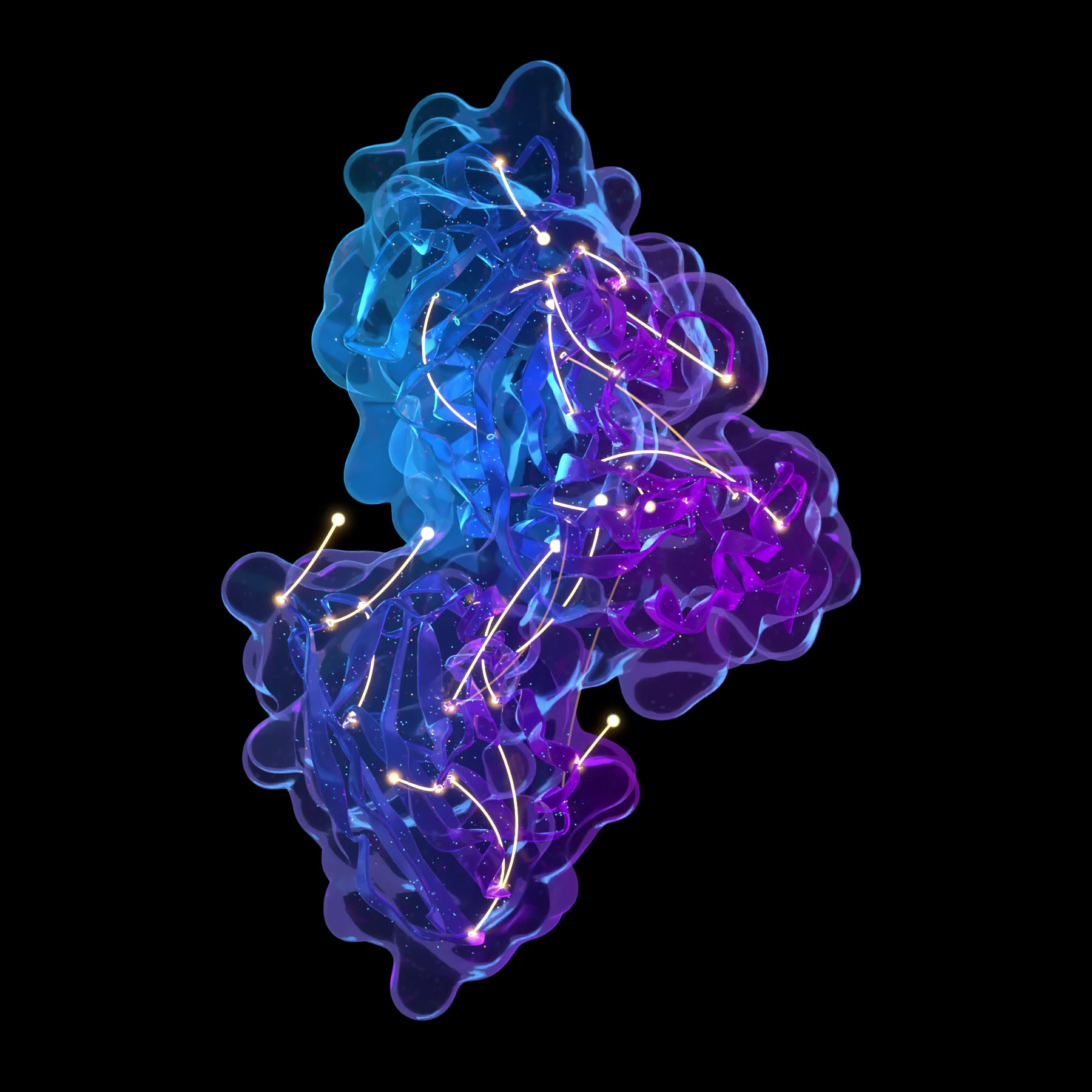
LARGE-SCALE PARALLEL PRODUCTIONAn automated gene synthesis and protein expression system connected to a liquid chromatography–mass spectrometry instrument, illustrated in blue and violet with a stream of golden signals.

From sequence to structural data

  1. 01

    High-throughput gene synthesis

    Synthesize target genes in parallel

  2. 02

    3-hour cell-free expression

    Produce protein samples rapidly

  3. 03

    High-throughput crosslinking MS

    Crosslink separately · pool after digestion

  4. 04

    SuperNovA MS analysis

    Experimental signals → structural data

Structural data, produced at scale

3hours

Rapid cell-free protein expression

>96samples in parallel

Automated batch preparation

>400proteins / MS / hour

Structural data acquisition

CORE ALGORITHMSRNovAAI for mass spectrometryExplore RNovA
STRUCTURAL DATA
  • Single proteins
  • Protein–protein
  • Protein–cyclic peptide
  • Protein–small molecule

Three core strengths.Stronger together.

High-throughput production and protein characterization build our experimental dataset. As it grows, we plan to develop AI protein design and bring new sequences back into the lab for validation.

SuperNovA and RNovA turn mass spectrometry signals into data for model learning.

DATAEXPERIMENTAL DATAACCUMULATE · LEARN · REFINE

Produce

High-throughput gene synthesis3-hour cell-free protein expression

Characterize

Crosslinking MS analysisProtein characterization & sequencing

Design

IN DEVELOPMENT

AI-guidedprotein design

Planned following 3–4 more months of data collection

More structural data.Through AI and high-throughput science.

Based in Zhangjiang, Shanghai, NirvanaBio is developing Nirvana 1.0, an ultra-high-throughput platform for protein structural data, and RNovA, an AI model for mass spectrometry.

Founders

Founders

Zeping Mao

Zeping MaoPhD

CEO & CTO

Founders

Ming Li

Ming LiFRSC

Co-Founder

Core Team

Core Team 1 / 3

Jie Liu

Jie Liu

Principal Scientist, Biotechnology R&D

  • PhD & BSc, Life Sciences
  • Tsinghua University
Yixin Zhang

Yixin Zhang

Chief Business Officer(CBO)

  • MBA, Peking University
  • BSc, Tsinghua University

Core Team 2 / 3

Zhuo Chen

Zhuo Chen

Artificial Intelligence Scientist

  • PhD, Computer Science
  • University of Waterloo
Yandong Zhu

Yandong Zhu

Digital Technology Director

  • MMath & BCS
  • University of Waterloo

Core Team 3 / 3

Yuxin He

Yuxin He

Strategy Development Director

  • PhD, Biomedical Engineering
  • Master of Management
  • City University of Hong Kong
Shuai Zhang

Shuai Zhang

Biomanufacturing Director

  • MSc, Biology
  • Anhui Agricultural University
  • Pharmaceutical Marketing

Academic Partnerships

Swipe to explore our academic partners

Bayer Co.Lab Side by side in Shanghai.

NirvanaBio, Bayer Co.Lab, Building R02, 990 Guoshoujing Road, Pudong, Shanghai

View map